
Castlevania Before Castlevania! Ghost Manor (1983)

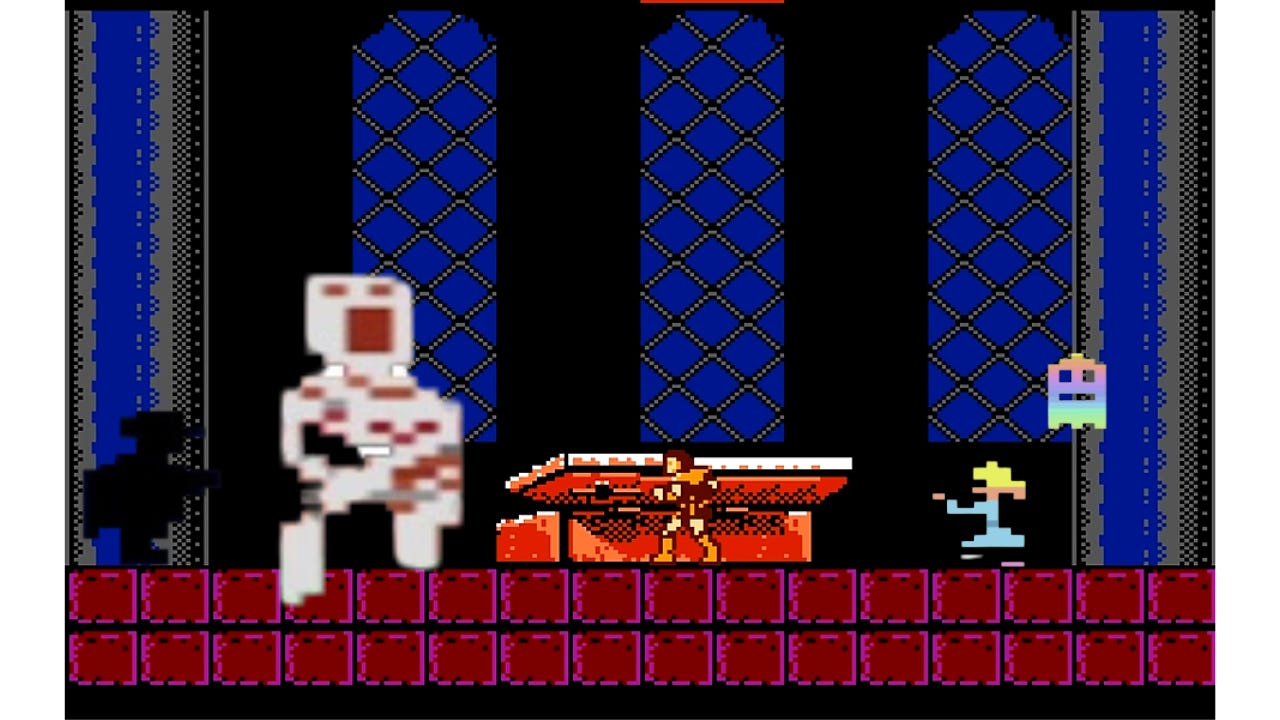
Castlevania might be the ultimate monster mash. It might be hard to tell with recent installments and adaptations, but the Castlevania series is rooted in Universal and Hammer horror.
The soul of Castlevania is in those old horror films. That’s why the game gives funny actor credits for all the monsters once the player beats the game. That’s why the title screen looks like a film strip. That’s why Dracula’s castle includes the Frankenstein monster, an army of hunchbacks that may or may not be from Notre Dame, a mummy, and creatures that jump from a black lagoon.
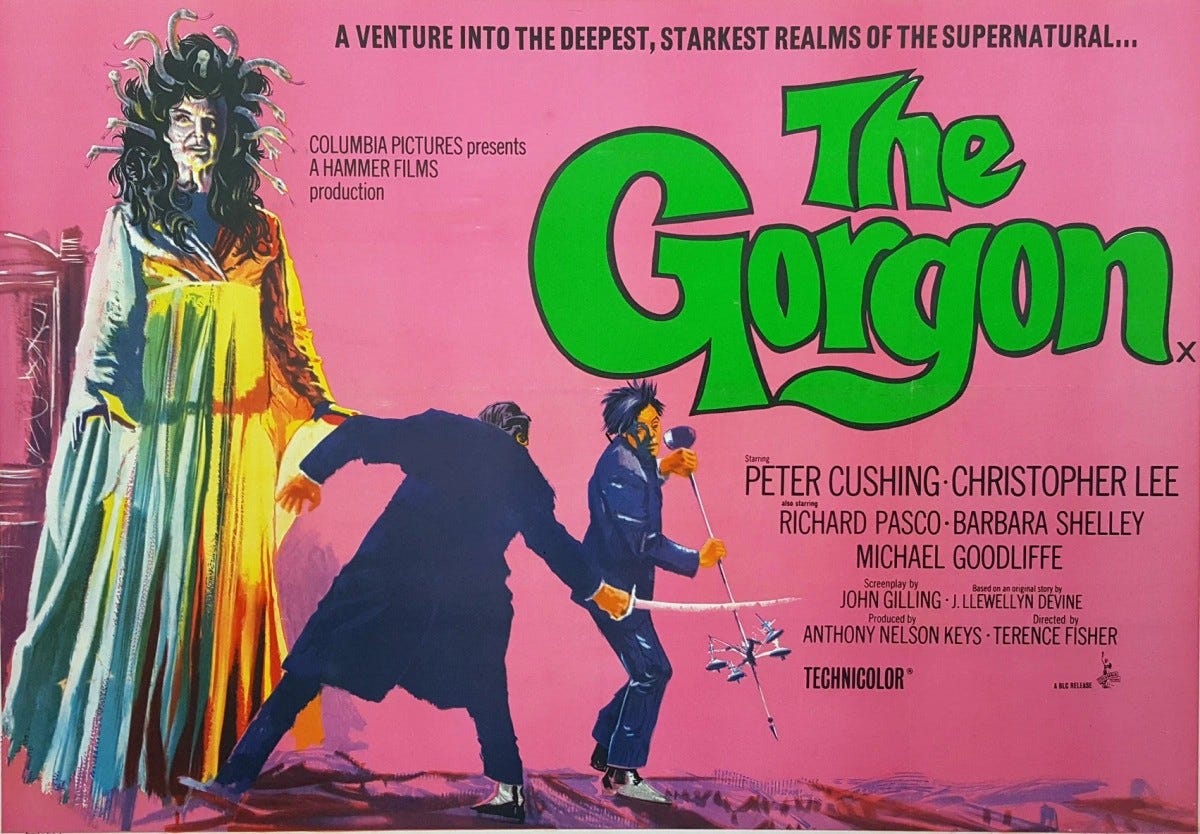
Even the giant Medusa head boss and numerous smaller Medusa head minions are a reference to Hammer’s 1964 film The Gorgon.
Castlevania was a monster mash, and its classic gameplay made it a graveyard smash, but there was a game earlier than Castlevania in which the hero raided Dracula’s castle, fought through a horde of monster minions, and put the Count down for the count. The name of this game: Ghost Manor.
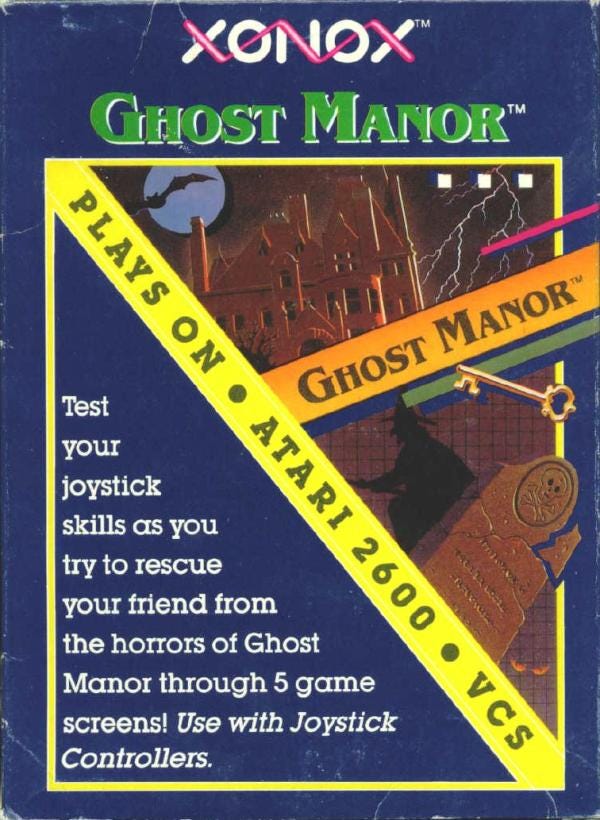
Ghost Manor was programmed by an unknown person for small developer Xonox in 1983. Like Wizard Video Games, the developer of Halloween and The Texas Chainsaw Massacre, Xonox started and ended during the video game crash of 1983.
Xonox had a plan to weather the crash, though it didn’t do them much good: two-in-one cartridges. Ghost Manor was put on cartridges with Artillery Duel, Spike’s Peak, and Chuck Norris Superkicks.


Xonox’s two-in-ones couldn’t gain traction, and in a year Xonox was history. Their strategy might have been doomed from the beginning.
Multi-game cartridges have always been associated with dodgy quality. The infamy of Action 52 for the NES is widely known, and cheap Chinese handhelds loaded with ROM dumps from the Internet show up at flea markets around the world.
Ghost Manor might have fared better if it were released by itself, because the game, while flawed, was decent by 1983 standards and had some creative touches that make it worth trying out today.
As with Castlevania, the plot of Ghost Manor is very simple. The player controls a boy or a girl, and they have to rescue the one not controlled by the player from Dracula’s castle, which is called Ghost Manor.
I think Castlevania is a cooler name for Dracula’s castle, but it’s the count’s property, so he can call it whatever he wants. Maybe the name sounds cooler in Drac’s native Romanian? In Romanian, it’s “Conacul Fantomă.” That’s better, but I still think Castlevania sounds cooler.
I prefer to play as the girl, because she runs with her arms out and looks like she wants to strangle the rainbow ghost at the start of the game. Everyone that plays Ghost Manor will want to strangle the rainbow ghost when they’re done.
The player character can be switched at any time by toggling the television type switch. They can even be switched when they’re both on-screen together.
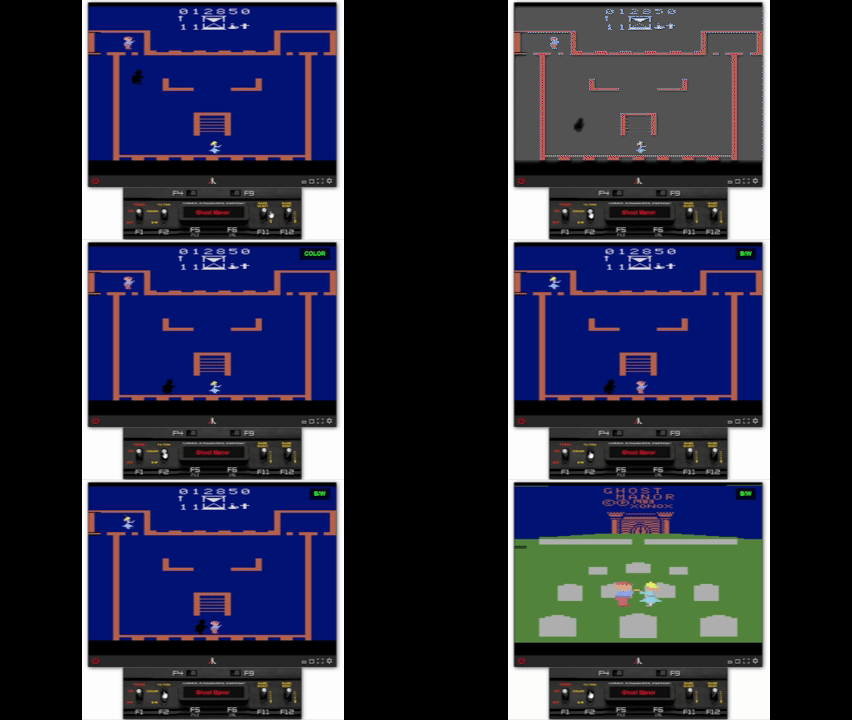
For those out there who don’t know, the Atari 2600 had a switch for color televisions and black and white televisions, because back in the 1970s not everyone owned a color television. If a family bought a color television, their older black and white televisions were passed down to the kids to play video games on. Atari including a television type switch was an example of them understanding the market of the late 1970s, but not how the market would evolve. It was a flaw that would cost Atari, and then when they could no longer pay the cost, destroy them.
The television type switch didn’t actually do anything besides create a signal, so it was up to game developers to decide what it did, if anything. Since optimizing sprites for black and white televisions wasn’t a priority for game developers given how rapid the American public switched to color, the switch was often repurposed for various options like character switching in Ghost Manor.
Ghost Manor is divided into five screens. For the first screen, the player has to acquire magic spears for use during the second. These spears are gained by chasing a rainbow ghost around a cemetery, or on different difficulty settings, a skeleton named Bones. The difficulty settings have nothing to do with how hard the screen is. The only thin it changes is how many spears are collected before the next screen.
According to the game manual, Bones and the rainbow ghost are friendly monsters, but you have to play a game of tag with them before they’ll hand over their magic spears.
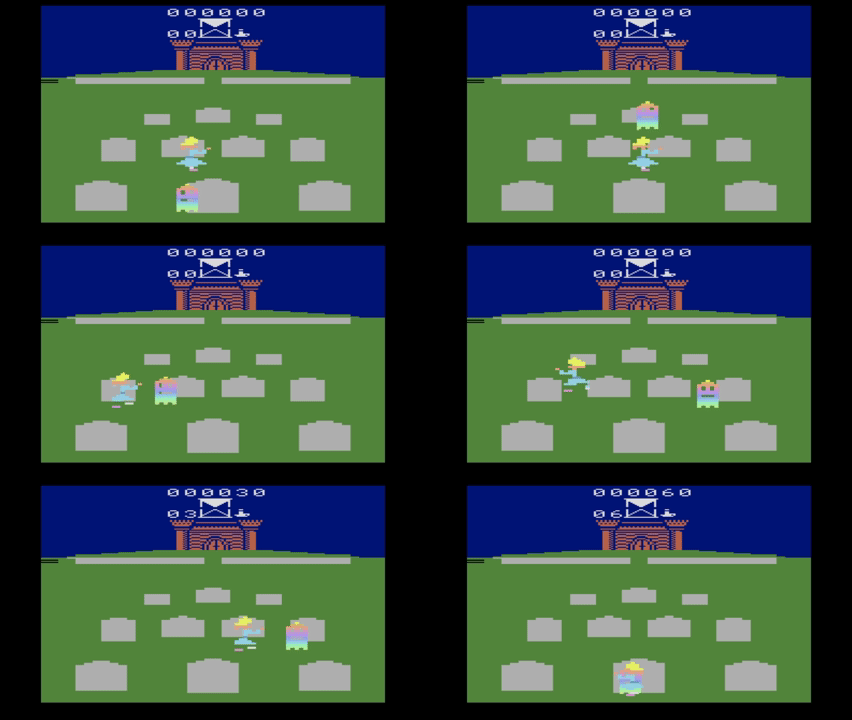
Why do they make the player character go through a game of tag? Their friend is in the clutches of Count Dracula! Why not hand over the spears? Is the game of tag supposed to be some kind of combat training? If so, I think throwing stuff at targets would have been better training for what lies ahead.
It’s probably best not to think too much about the plot; otherwise, it invites questions that cannot be answered, like how Bones and the rainbow ghost got their hands on a bunch of magic spears in the first place.
Players will come to hate the first screen. The second screen is where the game starts getting good and becomes an inventive take on Midway’s Satan’s Hollow, but the player has to first go through a tedious game of chase, and if they die at any point in the game, they don’t go back to the fun Satan’s Hollow screen; they come back to the boring chase. It’s like if Space Invaders made the player chase down an Ewok before letting them shoot aliens again.
The second screen is the best part of the game. The castle looks awesome with all of Dracula’s minions running around. There’s a big white guy the game manual calls a mummy guarding the gate; there’s a black knight manning the ramparts, there are bats flying high in the sky, and overall it looks really nifty.
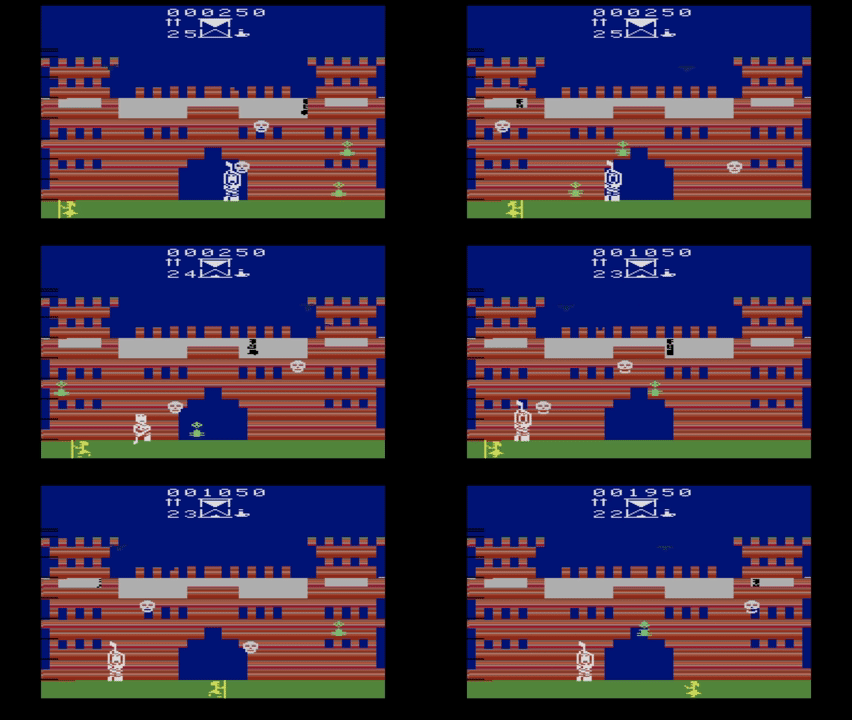
The only enemy that attacks the player is the mummy. He’ll chase the player and attack with two quick chops followed by a slightly delayed chop.
At the risk of being shamed for bringing up old Internet content, the mummy’s pattern is smash, smash, smash. The mummy can’t be killed until all the other enemies are killed, but then all it takes is getting right up in his face and pressing the fire button.
Some of the coolest video game enemies are the ones that follow the example of the Pac-Man ghosts and go from being invincible enemies that hunt the player to vulnerable targets hunted by the player. The mummy falls in that category, even though he looks more like a snowman that’s seen too many Friday the 13th films to me.
The third and fourth screens take place inside Ghost Manor. The only enemy is a moving wall. If it catches the player, it’s game-over, but while it’s moving away, the player can count coup and touch it to quickly score a lot of points. The regular walls don’t kill the player, but they are electrified and can stun the player long enough for the moving wall to do its job.
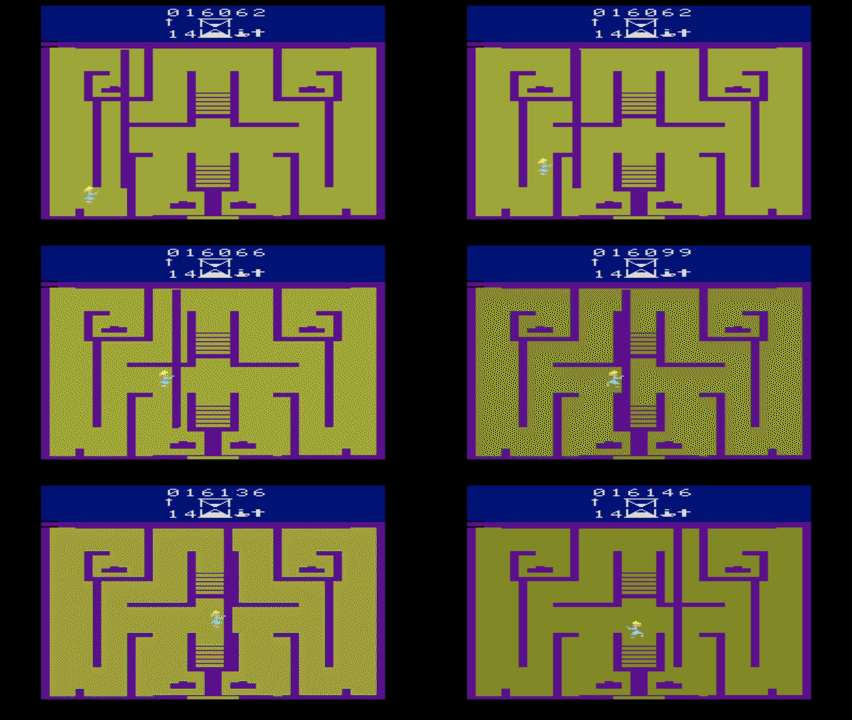
There are several coffins inside the castle. One coffin on each floor holds a cross. Crosses are used to defeat Dracula, and while the player is given one when they arrive at Dracula’s lair, they might want two more for insurance, as each cross can only be activated once.
It’s a little tricky opening coffins. The game manual says that they have to be touched “just right” to open, and the direction they have to be pushed seems random. They will make a loud creaking sound when they’ve been opened, but there’s no visual indicator.
It’s not a bad mechanic, though it may be frustrating to some players. It adds to the horror of the game that a player has to play a guessing game with coffins while a killer wall closes in.
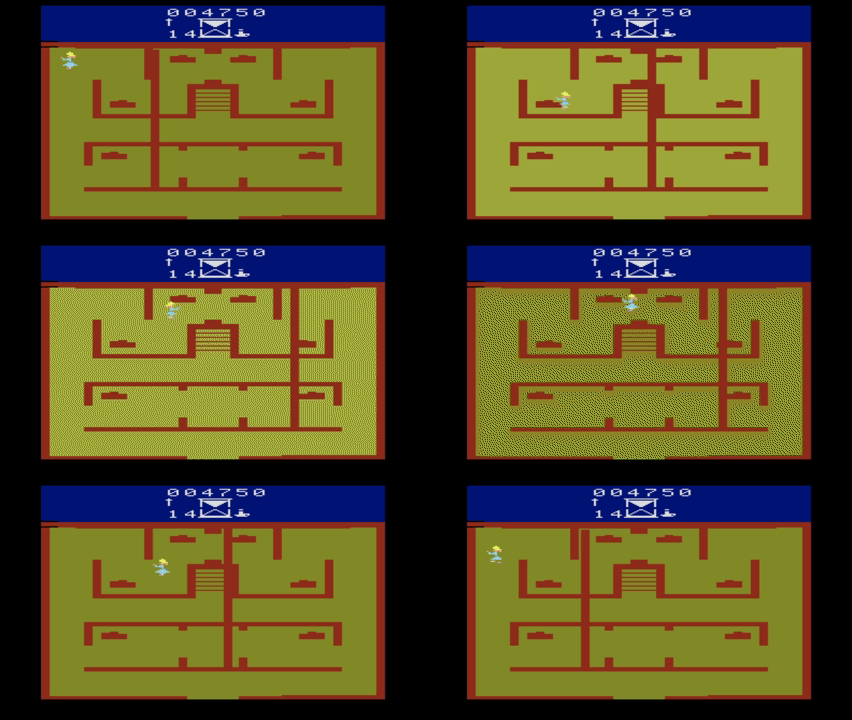
On harder difficulties, the screen sometimes turns dark, and that makes the castle floors much harder. It’s not hard to dodge the moving wall when it can be seen, but it’s an entirely different thing when it can’t. Players should try the game with the darkness activated. It’s fittingly challenging and scary.
It’s a little unclear why Dracula has coffins with crosses inside them in his castle. Using what Hammer films have taught me about vampires, particularly 1966’s Dracula: Prince of Darkness, I can guess that those coffins contain Dracula’s vampire rivals and that he had his minions place crosses inside their coffins to keep them imprisoned. If that’s the case, there are two vampires running free after the game.
The fifth and final screen is where Dracula is confronted. The character that isn’t controlled is kept in a prison cell while Dracula chases after the character that is. To beat Dracula, the player has to attack him with the cross from below. The cross doesn’t work if used from any other position. It’s trickier than it seems to get below Dracula as the Count moves faster than the player.
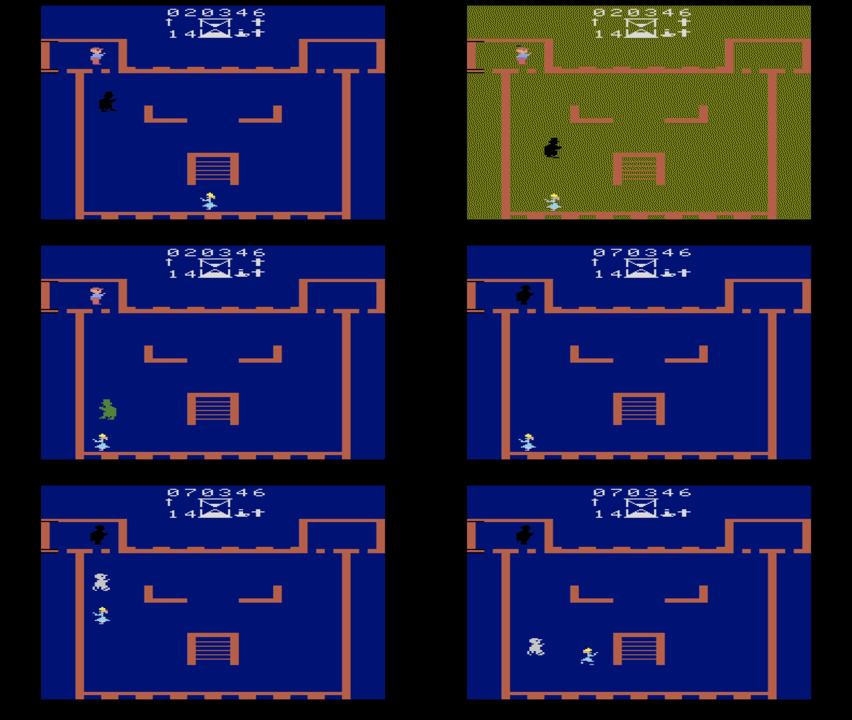
According to the occult, the cross should be used on Dracula from the east. That is the direction from which the sun rises, and to quote Van Helsing from the novel, “His power ceases, as does that of all evil things, at the coming of the day.”
The occult philosopher Emanuel Swedenborg associated east and west with good and evil. His metaphysical afterlife didn’t have directions as humans know them, but the worst hells were in a direction like that of the west, and the best heavens were in a direction like that of the east.
The best vampire takedown, according to the occult, is one launched on a bloodsucker from the East while they stand in the West.

The fight with Dracula is fittingly creepy. The game is very noisy. Everything makes noise. The chirping rainbow ghost, the chopping mummy, and the creaking coffins all make a lot of noise. Everything makes noise except Dracula. Dracula stalks in complete silence as a jet-black shadow.
Years before Nintendo had players fight a living shadow in Zelda II: The Adventure of Link, Xenox was having players fight a shadowy Dracula, and while Dracula doesn’t copy the player’s moves, he does react to them, because the way he moves is entirely determined by how the player moves.
When the cross is used on Dracula, he isn’t destroyed, because technically crosses don’t destroy vampires. Instead, they repel them. Van Helsing remarks of Dracula and crosses that “in their presence he takes his place far off and silent with respect.”
That is to say, he runs away, as he does in Ghost Manor. He spins around and floats up, but he’ll come back unless he’s sent flying into one of the cells. It can even be the cell the love interest is held in.
Once Dracula is imprisoned, the love interest escapes and is alright, though very pale. They probably lost a little blood from Dracula’s involuntary blood drive, but they’ll be fine after a cookie and juice drink. They have to be escorted down the stairs, which is a cute way to end the game.
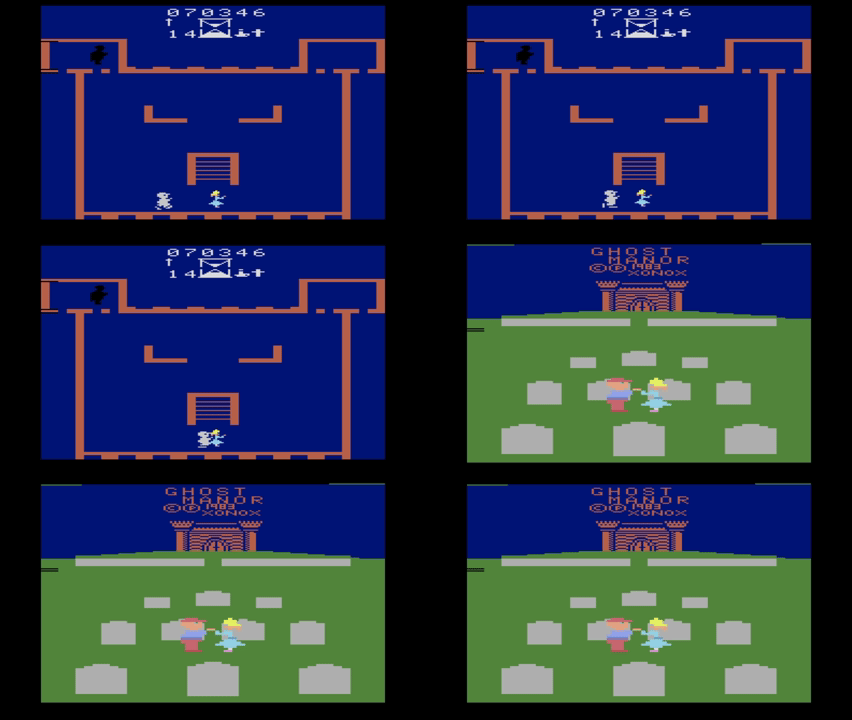
In most Dracula films, he’s destroyed at the end. Here, he’s just captured. The only film I can recall where Dracula gets imprisoned within his own castle is Legend of the Seven Golden Vampires, and that’s only at the start of the film.
The hero/heroine left the job half-finished, but I suppose it would be unfair to make too big a deal about it. They’re not vampire hunters like Simon Belmont or Van Helsing. They’re just two weird people that like hanging out in graveyards.
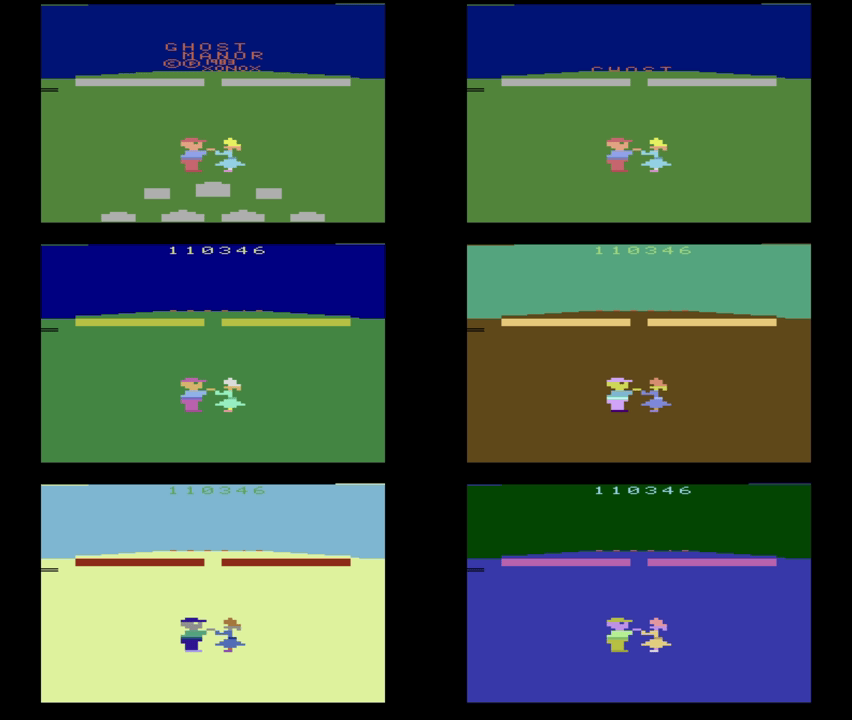
Ghost Manor is an okay game that feels like the start of a great game. Xonox should have taken out the first screen and repeated the other four. A game about taking down multiple castles full of monsters could have been excellent.
One castle could have been controlled by a werewolf, and his trick could have been that he could only be hit when clouds moved in front of the moon. Another could have been controlled by a mad scientist that fought with a robot that had to be tricked into falling down a pit.
Mixing up shooting stages with puzzle-based bosses would have made for something very good, maybe even good enough to stand with Atari classics like Yar’s Revenge and Demon Attack. Alas, Xonox probably had to save space on the cartridge for Chuck Norris Superkicks.